
Contributions by Maria Martinez
For too long, bilingualism in schools has been framed as something students need to fix, accelerate, or overcome. But what if we’ve been asking the wrong question? In my recent conversation with Maria Martinez, a bilingual educator and creator of Bilingual Cerebros, we explored a truth that educators around the world are slowly beginning to embrace: bilingualism is not a deficit. It is an asset. A cognitive, cultural, and academic asset. And Maria doesn’t speak about this from theory alone. She speaks from lived experience. She is, after all, a teacher who has worked in three countries and is a multilingual learner herself
Maria’s journey spans Spain, England, and Germany. Originally trained in Spain, she built her career in England and now teaches in Germany. That alone gives her a rare lens into how different systems approach language instruction. “I was trained mainly to be an English teacher to start with,” she explains. “But then life took me into different paths as it always happens.” In England, she developed a curriculum without relying on textbooks. In Spain and Germany, textbooks were central. Through these contrasts, she began to notice gaps, particularly around progression and scaffolding.
“There isn’t really a progression,” she said when reflecting on some materials she encountered. “I like to have a steady progression so that the students don’t feel so lost and they feel like there’s scaffolding and there are things in place to keep them secure.”
That word. Secure. It matters.
For Maria, security is the foundation of learning. “When students know where they are going and why, they stop guessing and start thinking.”
Too often, we equate rigor with the removal of support. But Maria’s work reminds us that scaffolding doesn’t weaken instruction. It strengthens it. It builds confidence. It creates cognitive safety. And perhaps most powerfully, her perspective deepened when she became a language learner again. “After 20 years, we moved to Germany. So I had to start from the beginning and learn German myself. So I like to think of myself not only as a teacher, but also as a learner. And that really helps because I think it helps me understand my students better.”
The Myth of “Pure Immersion”
One of the most powerful moments in our conversation centered on the idea of bilingual resources. Maria initially created fully bilingual materials. Mainly, it was Spanish and English activities side by side.
Some critics pushed back.
“Many people say, well, that’s not immersion in the language.” But her experience told her something different. “I’ve seen that it actually helps you.” She has often observed how comprehension changes behaviour. “Students relax physically when they realise they are allowed to understand, and that changes their willingness to participate.”
She described how bilingual scaffolds allow learners to compare structures, understand context, and build bridges between languages, not walls.
Later, as proficiency grows, she gradually removes the scaffolds.
“You can start with both languages, but then move on and take one of them away when they are ready.”
This is the “training wheels” effect we discussed in the episode. It’s a practical metaphor that resonates deeply in literacy instruction. The goal is independence. But independence is built through strategic support. Not subtraction of it. Just like teaching a child to ride a bike, keeping those training wheels on long enough for them to grow confident in peddling completely on their own. The same applies to language learners. The guide rails are in place. You walk along with them as they peddle. Until eventually, they are moving on their own.
From Deficit to Asset
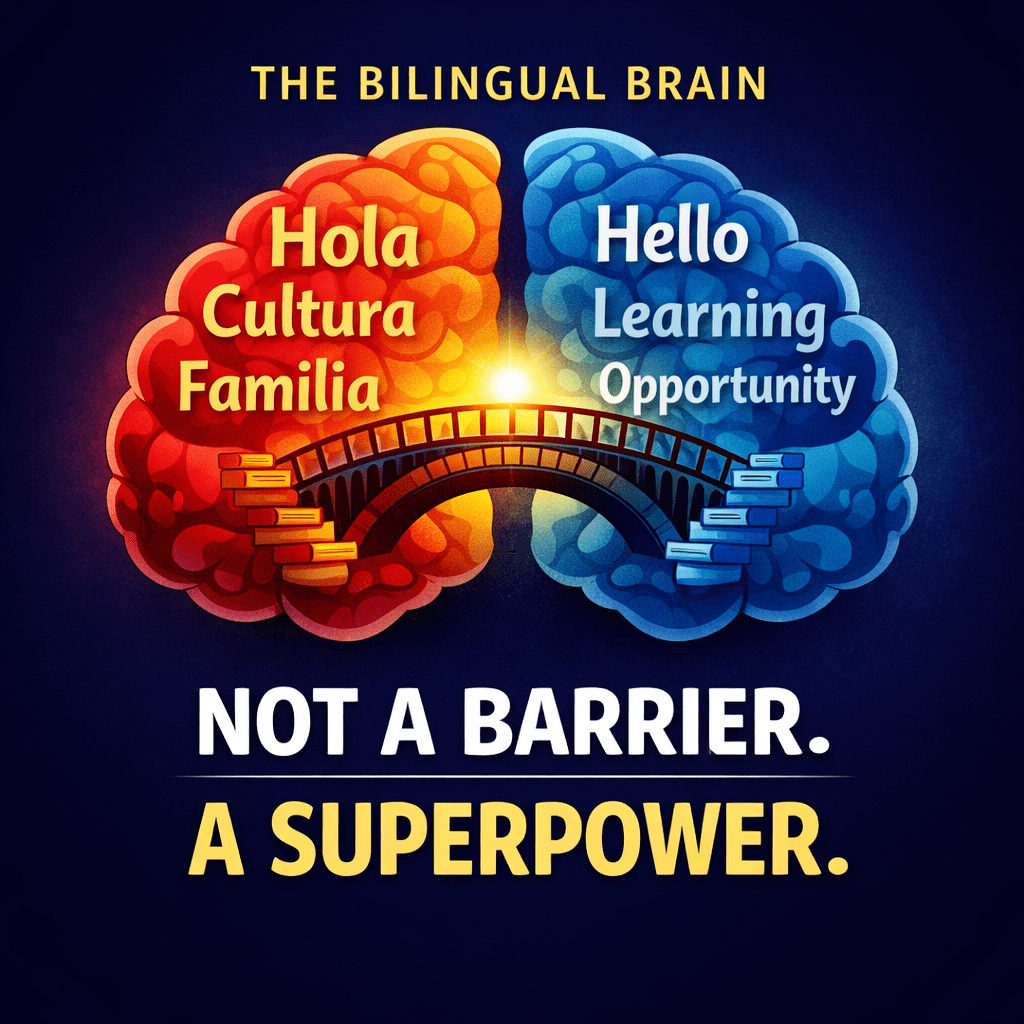
Perhaps the strongest thread running through our discussion was the shift in narrative, from seeing bilingualism as a barrier to seeing it as a superpower. Maria put it plainly:
“It’s considering one language and the other language at the same level and not seeing that you are learning one language separate from the other one, but together.”
Maria links this shift directly to student confidence. “Many bilingual students don’t struggle because they know less, but because they are constantly switching systems. Once that is acknowledged, confidence appears almost immediately.”
Keeping in mind the simultaneous nature of bilingualism is truly at the heart of the matter. Too often, we treat languages as isolated compartments. English here. Home language there. But bilingual brains do not operate that way. They develop in a relationship. In interaction. Maria expanded on this idea beautifully:
“Why not think of bilingualism as the two languages being together, growing together, and knowing how to say one particular word or an expression, learning how it works… it grows at the same time without separating them.”
This is not just a philosophical stance. It is neurological. It is cognitive. It is identity-driven. And it is transformative for students.
The Human Element: Identity and Evolution
Another powerful moment in our conversation was Maria’s reflection on language as something living, not static. “Languages are not dead things… [It’s alive]. It keeps changing in all languages.” For Maria, language always carries relationships as well as meaning. “When a child loses access to one language, they also lose access to part of their emotional world.”
That observation extends beyond vocabulary shifts or generational slang. It speaks to identity. To heritage. To belonging. When students bring their home language into the classroom, they are not merely bringing a different set of grammar rules. They are bringing history, family, worldview, and memory. And most notably, their words carry their culture, which is shared in everything they do, both verbally and in how they carry themselves. The notion of culture and language being inseparable twins underscores the implicit social norms that likely have different respect and hierarchical significance. To suppress that is not just pedagogically unsound. It is humanly costly. It does, however, require some understanding of the cultural backgrounds of the students you teach (not just what kinds of foods they eat or what religion they practice).
Embracing AI & New Materials
Maria also made an important comparison to technology, particularly AI. She pointed out the resistance educators often show toward change:
“[Like] with technology,” she explains, “people are like, ‘Oh, they’re going to take my jobs away.’ No. Learn to work with them.” The same applies to bilingualism. We don’t compete with it. We work with it. We leverage it. We honor it. And it isn’t like it is going away if we close our eyes and wish it so. Technology is advancing at a pace none of us is truly ready for. But that isn’t something we can change through debate. We simply have to evolve with everything that is happening. Our students have to, and thus, we have to.
The same is true for any material we work with in the classroom. Either on paper or online. As someone who has spent years developing literacy curriculum for English learners, I found our conversation deeply affirming. When we stop lowering expectations and start honoring the brilliance already present in our classrooms, outcomes change. So, Bilingualism is not something to fix. It is something to cultivate. Maria’s journey (from Spain to England to Germany, from teacher to learner and back again) embodies this truth. Her work through Bilingual Cerebros continues to provide resources that reflect this asset-based mindset.
And this conversation is just Part 1.
If you are an educator, school leader, or advocate for multilingual learners, I invite you to watch the full interview and reflect on how your own classroom narrative might shift. María’s goal has always been clarity and communication, rather than forcing students to choose between languages. “I don’t want students to feel they must pick a language. I want them to feel they can think fully in both.”
The bilingual brain is not a barrier. It is a bridge. And it’s time we start teaching like we believe that.
Leave a Reply