
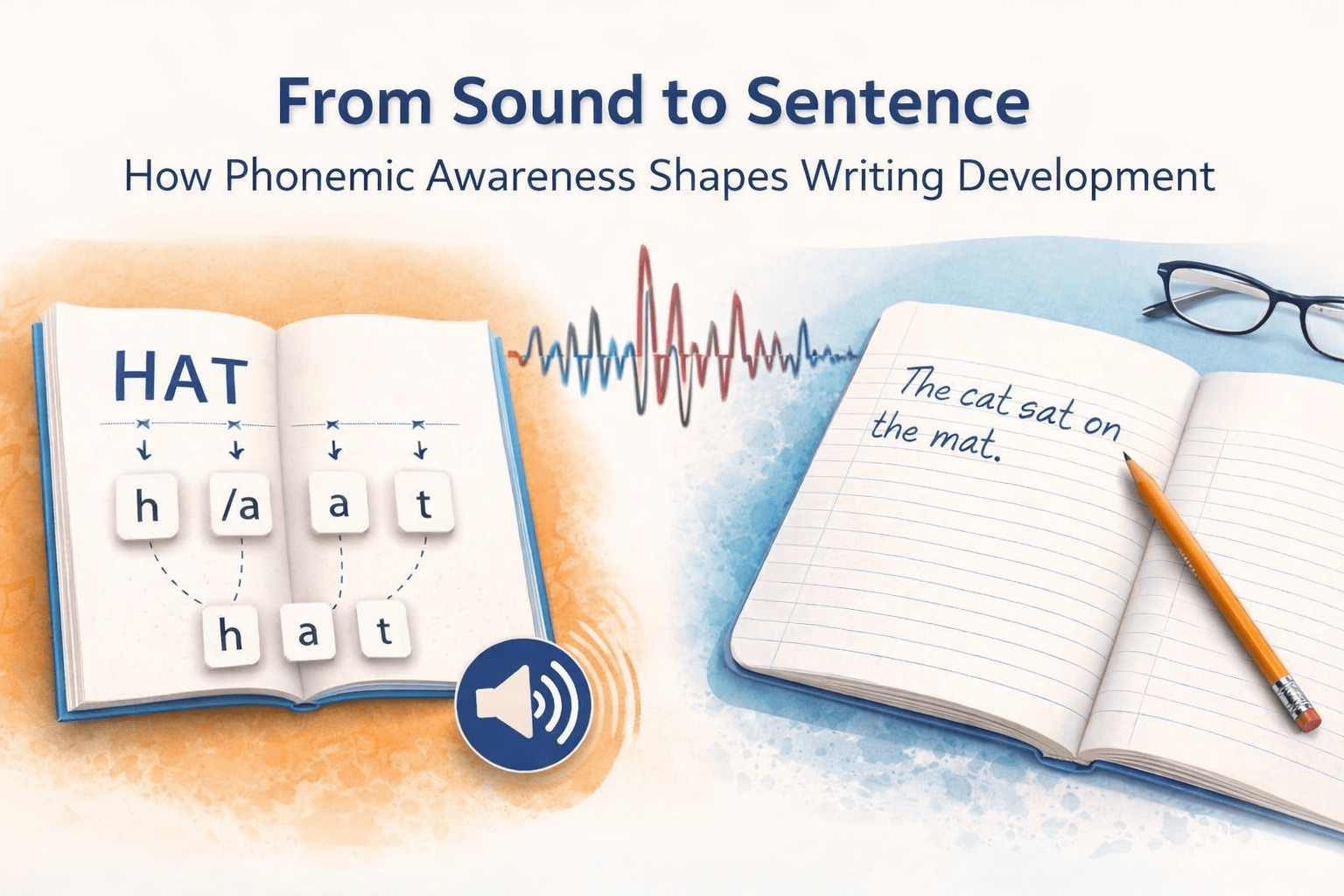
In many classrooms, writing is treated as the final step in language learning and the summit students reach after they’ve learned to read. However, for English learners, especially adults, the path isn’t always linear. Writing doesn’t come after reading. It develops alongside it. Perhaps this is part of the (sometimes) painful language acquisition process, but it is necessary, and English learners largely understand this investment of internalizing these complex skills simultaneously is non-negotiable. At the center of this process is the lifeblood of writing instruction: phonemic awareness.
This is the x-factor, the “secret formula,” the oxygen necessary for the full balance of writing in an L2 to come to fruition. Phonemic awareness is the ability to hear and manipulate the individual sounds in words. This is what learners ultimately need in order to command, segment and blend sounds into meaning. To be fair, instructional emphasis on developing phonemic awareness from the most basic level is often associated with early childhood education, but its importance does not disappear with age. In fact, for English learners, it becomes even more critical well into adulthood. Research continues to affirm this.
A study published in the South African Journal of Communication Disorders found that phonemic awareness (particularly skills like segmentation and blending) is directly tied to literacy development and is often underdeveloped in English second language learners . It is widely believed increased phonemic awareness isn’t merely a product of efficient instruction, but rather the result of sufficient exposure.
A 2023 study on adult EFL learners found a strong positive correlation (r = .818) between the amount of time learners engage with English outside the classroom and their phonological awareness . In other words, the more learners interact with English in real contexts (reading, listening, conversing, etc.) the stronger their ability to process sound structures becomes. This is clearly more important than people realize. Keep in mind when learners lack this foundation, writing becomes guesswork.
Phonemic awareness is not just about pronunciation, but access. The research shows that phonological awareness is one of the strongest predictors of reading ability and overall literacy success . At the same time, increased exposure to English (especially through meaningful, real-world interaction) strengthens that awareness over time . In contrast, lack of sufficient interactions inevitably stifles growth in the language acquisition process overall, so encouragement in real-world situations (simulated or not) is vital to learners’ advancement.
When learners develop the ability to distinguish sounds accurately, a powerful transformation begins to unfold in their language development. They start spelling more effectively, recognize words more quickly while reading, and gradually internalize the underlying patterns of the language. This refined precision frees up valuable cognitive space, allowing them to move beyond the mechanics of decoding and encoding words and instead direct their mental energy toward meaning and comprehension. At this pivotal stage, writing truly begins to take shape. Learners are no longer bogged down by the struggle to form each individual word. They shift their focus from arduous mechanics to genuine expression, confidently articulating their thoughts and ideas with greater fluency and purpose.
For many English learners, especially those whose first language has a completely different sound system, the challenge is even greater. Research shows that differences in phonological systems (such as vowel distinctions) can make it difficult for learners to accurately perceive and produce English sounds . At the same time, without sufficient exposure to English outside the classroom, learners may not get the repetition and variation needed to strengthen these distinctions. The same 2023 study highlights that both spoken and written exposure to English have strong correlations with phonological awareness (r = .758 and r = .726). This included conversation, media, or digital interaction, but frequency of the interactions is clearly a determining factor. This tells us something important: Phonemic awareness is not built in isolation. It develops through interaction, repetition, and meaningful use. Essentially, when learners cannot hear the difference between sounds, they cannot reliably write them.
Writing as a Natural Extension
In our classrooms, we often see a breakthrough moment when students begin to hear the words before they write them. That moment is not accidental. It is the result of both intentional instruction and consistent exposure. Phonics, when taught intentionally, becomes the bridge. But exposure (what learners do outside the classroom) becomes reinforcement. For example, reading a message, watching a video, listening to a song, or writing a post. These are not extra activities. They are part of the learning system. Together, they connect phonemic awareness to reading, and reading to writing. They allow learners to move from isolated sounds to complete sentences, and eventually, to meaningful communication.
When phonemic awareness is thoughtfully woven into writing instruction and enriched by meaningful real-world exposure, even the simplest classroom activities transform into powerful catalysts for literacy growth. In shared writing sessions, for example, students actively segment and blend sounds as they collaboratively construct sentences. Dictation exercises, on the other hand, invite them to apply their phonics knowledge in real time with purpose and immediacy. Through carefully scaffolded guided practice, learners gradually transition from scaffolded writing projects to confident, independent expression.
Beyond the classroom walls, authentic encounters with English (again, engaging through media, interactive technology, and everyday social interactions) further deepen their connection to the language. Research consistently affirms the strength of this integrated approach: explicit phonological instruction builds a solid foundation for literacy, while real-world exposure to English amplifies those gains by dramatically increasing learners’ contact with rich, authentic language in natural contexts. Ultimately, these are not separate pathways. They form a single, harmonious system in which phonemic awareness, phonics, and lived language experiences work together to nurture fluent, expressive writers.
If we truly wish to support English learners more effectively, we must courageously rethink our approach to writing instruction. Writing is far more than mastering grammar or arranging tidy structures on a page. At its core, it begins with the subtle awareness of sounds. Yet, it blossoms and energizes through meaningful, repeated use. Thoughtful instruction builds the essential phonemic awareness that is vital for enriching language skills. The rich exposure strengthens and deepens it, and purposeful writing brings it to life. When we intentionally align these three elements (awareness, exposure, and expression) we do more than help students decode and read; we equip them with the tools to write with growing clarity, genuine confidence, and authentic purpose. In that powerful process, the realization dawns that writing is no longer a distant, intimidating skill just out of reach. It becomes real, personal, and deeply their own.
In every classroom, there are students brimming with ideas, eager to say far more than they can yet write. Our sacred role as educators is not to lower expectations or simplify the task, but to close the gaps by strengthening the foundation and opening wider doors of access. It begins with sound, honing in on the precise awareness of phonemes that unlocks spelling, reading, and expression. It grows through rich, real-world experience that turns isolated skills into living language. And from that solid ground, confidence, creativity, and voice begin to flourish. When we build this way, writing stops being a wall and becomes a highway to their brightest potential. Because the most powerful moment in any classroom is the instant a student pauses and truly understands they have something important to say… and can finally know how to write it.
References
Brennan, C., & Booth, J. R. (2015). Large grain instruction and phonological awareness skill influence rime sensitivity, processing speed, and early decoding skill in adult L2 learners. Reading and Writing, 28(7), 917–938. https://doi.org/10.1007/s11145-015-9555-2
Giambo, D. A., & McKinney, J. D. (2004). The effects of a phonological awareness intervention on the oral English proficiency of Spanish-speaking kindergarten children. TESOL Quarterly, 38(1), 95–117.
Hismanoglu, M. (2012). An investigation of phonological awareness of prospective EFL teachers. Procedia – Social and Behavioral Sciences, 31, 639–645.
Sa’adah, L., Anam, S., & Hentasmaka, D. (2023). Extramural English and adult EFL learners’ phonological awareness: A correlational study. Premise: Journal of English Education and Applied Linguistics, 12(3), 894–910. https://doi.org/10.24127/pj.v12i3.7735
Souza, H. K. (2015). Phonological awareness and pronunciation in a second language. Open Journal of Modern Linguistics, 4(4), 471–480.
Venkatagiri, H. S., & Levis, J. M. (2007). Phonological awareness and speech comprehensibility: An exploratory study. Language Awareness, 16(4), 263–277.
Leave a Reply