
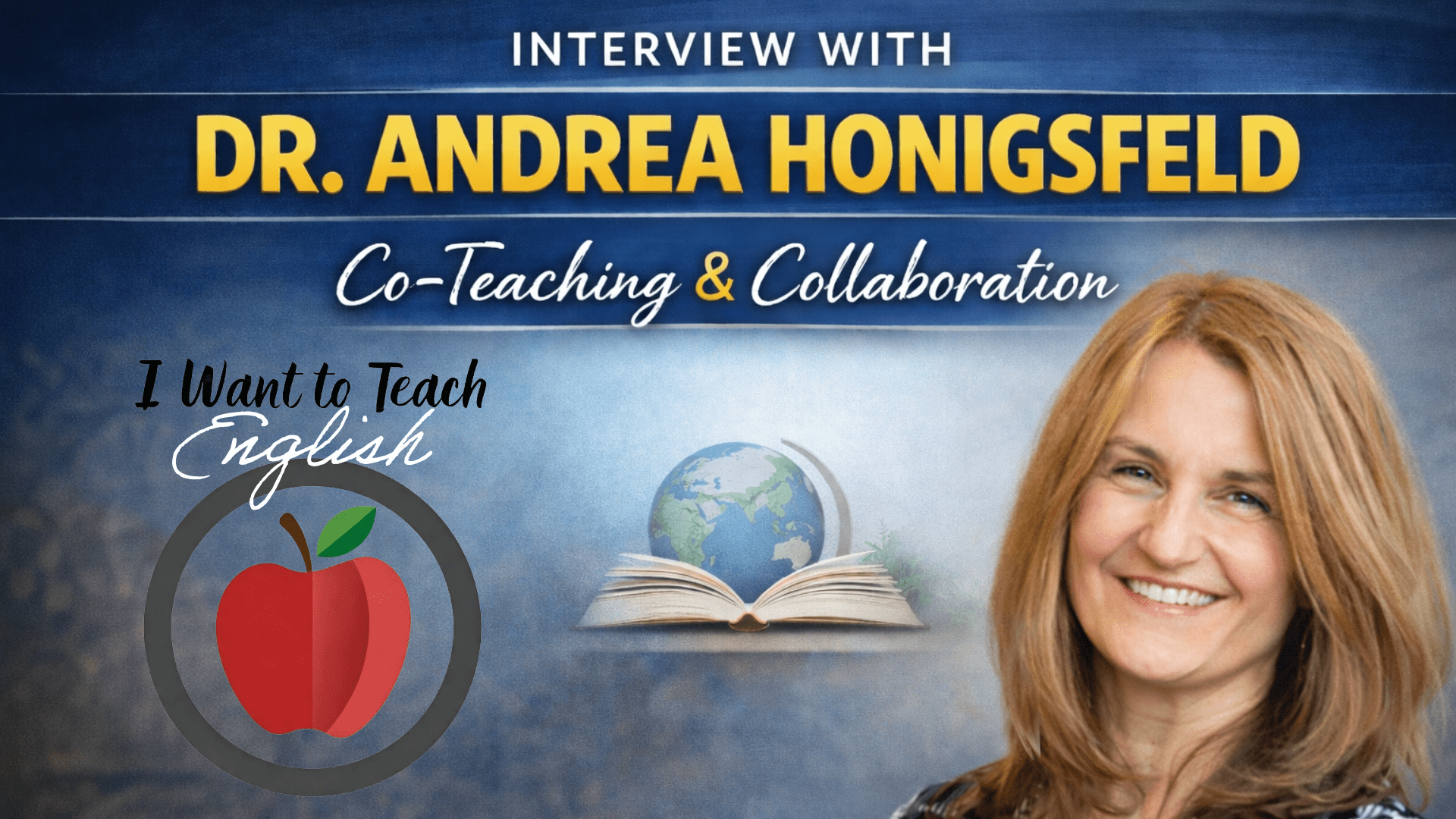
Working with a co-teacher can sometimes feel like living with a roommate you may not have chosen to live with, a tandem full of potential for harmony, but also ripe for misunderstandings and mismatched habits. Yet, as educators, we’re not just sharing space; we’re sharing the profound responsibility of shaping young minds, especially those of multilingual learners. It’s a very serious job. So, what if the secret to making it work isn’t perfect chemistry, but a deliberate focus on purpose? Recently on I Want to Teach English, I had the great privilege of having a conversation with Dr. Andrea Honigsfeld, a Fulbright scholar, international speaker, and one of the most influential voices in the field of English learner education. We ventured into this topic and much more, which opened my eyes on a professional level.
Our conversation touched on co-teaching, collaboration, professional partnerships, and the powerful role of multilingualism in the classroom. Dr. Honigsfeld’s extensive body of work, spanning over 27 books and numerous articles, has shaped how educators approach integrated practices for multilingual learners, emphasizing equity and evidence-based strategies. Her personal stories reached back to her early days immigrating from Hungary, and how a culturally common practice in her country led to her becoming a renowned voice in ESL education and bringing the co-teaching philosophy to the educational mainstream. “That was just the way things were done,” she shared. “It was business as usual.” When she transitioned to the U.S. school system during the rise of special education inclusion, she was surprised to find that few ESL colleagues embraced collaborative teaching. But she did. And that commitment never left her. This cross-cultural perspective highlights a broader theme in her career: the universality of effective teaching practices, adapted to local contexts, which she explores in depth in her collaborative works.
Collaboration Begins with Purpose, Not Personality
One of the most powerful insights from our exchange was the idea that successful co-teaching doesn’t begin with personal chemistry. It begins with a shared purpose. “People often get it backwards,” I said during our talk. They want personalities to click first. But really, it’s aligning around a common professional goal that unlocks everything else. Dr. Honigsfeld agreed, offering a story about two close friends who became co-teachers and struggled. Their friendship didn’t translate into a working partnership until they sat down, clarified expectations, and redefined their relationship around their professional roles. This anecdote underscores a critical analysis: while interpersonal rapport can enhance collaboration, it is not a prerequisite. Instead, focusing on purpose fosters resilience in partnerships, allowing educators to navigate conflicts and differing styles effectively. Research supports this, showing that purpose-driven teams yield higher student outcomes in diverse classrooms, as they prioritize instructional alignment over individual preferences.
In many districts, ESL & Gen Ed teacher pairings are administrative decisions. You don’t choose your co-teacher, you get placed with one, generally speaking. That’s why clarity, respect, and communication are non-negotiables from day one. “We need to center our relationships around students,” she said. “Because it’s about them. It’s always been about them.” Dr. Honigsfeld expands on these dynamics in her book Co-Teaching for English Learners: A Guide to Collaborative Planning, Teaching, Assessment, and Reflection, where she outlines practical frameworks for building such partnerships, including co-planning protocols that emphasize shared goals to mitigate mismatches in assigned teams. This approach not only improves teacher efficacy but also models collaborative problem-solving for students, reinforcing a classroom culture of mutual support.
Deficit Thinking and the Role of Translanguaging
Our conversation naturally led into the persistent misconceptions surrounding English learners, issues I encounter regularly in my own practice. Dr. Honigsfeld pointed out that many educators still view multilingual learners through a deficit lens. “They are not behind,” she asserted. “They are linguistic geniuses. They’re developing multiple languages, and that’s an extraordinary cognitive achievement.” Analyzing this theme reveals its profound implications: deficit thinking perpetuates inequities by framing multilingualism as a barrier rather than an asset, leading to lowered expectations and segregated instruction. Shifting to an asset-based mindset, as Dr. Honigsfeld advocates, can transform outcomes. Studies indicate that recognizing students’ linguistic repertoires boosts engagement, academic performance, and self-efficacy.
We also talked about the risks of over-relying on translation or AI tools. While these can assist comprehension, they don’t ensure conceptual understanding. Translating complex historical or cultural terms like “westward movement” may not bridge the learning gap because it’s not just about language. It’s about context, meaning, and culture. Here, the analysis points to a key pedagogical pitfall: tools like AI can create a false sense of mastery if not paired with deeper instructional strategies, potentially widening gaps in content knowledge.
Dr. Honigsfeld emphasized the difference between translation and translanguaging as a pedagogy. “Multilinguals don’t store languages in separate drawers,” she said. “Their languages are fluid and interconnected. Translanguaging allows students to leverage their entire linguistic repertoire to make meaning.” This concept, central to her work, promotes fluid language use in classrooms, enabling students to draw on all their languages for learning. In Growing Language and Literacy: Strategies for English Learners, Dr. Honigsfeld provides tiered strategies based on proficiency levels, illustrating how translanguaging scaffolds comprehension and expression, fostering cognitive flexibility and cultural affirmation. Critically, this pedagogy counters monolingual biases, empowering students to construct knowledge authentically and reducing the emotional toll of language suppression.
Starting Where Schools Are
When I asked how schools just beginning their co-teaching journey should start, Dr. Honigsfeld was quick to caution against rigid models. “Begin with configurations,” she advised. “Are both teachers working with the same group at the same time? Are students being grouped for part of the lesson? These questions help shape what collaboration will look like before you ever define it by a model.” Expanding on this, schools can assess their readiness through self-audits, examining factors like staff training, resource allocation, and administrative support. An analysis of implementation challenges shows that flexible configurations prevent burnout and allow for gradual scaling, leading to sustainable programs. Dr. Honigsfeld’s Collaborating for English Learners: A Foundational Guide to Integrated Practices offers updated case studies and policy insights, demonstrating how adaptive models like parallel teaching or station rotations can be tailored to school contexts for maximum impact.
We also discussed visibility. Students must see both teachers as equal contributors. When co-teachers divide roles unfairly or fall into “main teacher vs. assistant” dynamics, we send the wrong message to kids and to colleagues. This imbalance can erode trust and reinforce hierarchies, but equitable visibility models parity, encouraging student agency and collaborative skills. It is an unfortunate reality and one that may be at the root of many heated disagreements between co-teachers. This rests at the crux of what I had alluded to earlier in the conversation: that personal likings are not as relevant as shared professional goals. Both co-teachers must agree to and collaborate to achieve these goals and that should be paramount to everything else. Personal beliefs, opinions and even friendships are great to have, but not necessary to have a great working relationship that churns out excellent results in the form of improved student output.
From Classroom to Community
Throughout our talk, Dr. Honigsfeld’s message was consistent: we co-teach not for convenience, but for the students. And we collaborate not because it’s trendy, but because it transforms lives. These values are at the heart of everything we do at IWTLE, from the adult writing curriculum I develop to the professional learning communities we build. Analyzing the broader themes, co-teaching and translanguaging extend beyond classrooms to community building, bridging cultural divides and promoting inclusive societies. Dr. Honigsfeld’s Breaking Down the Wall: Essential Shifts for English Learners’ Success delves into systemic changes needed for this, advocating for policy reforms that prioritize multilingual equity. Dr. Honigsfeld reminded me why we write, why we teach, and why this work matters. It’s about connection. About shared responsibility. About opening doors for learners of every background.
Watch the Full Interview
I encourage every educator, administrator, and advocate to watch the full video. Share it with your team. Start a conversation. And if you’re ready to bring these ideas to your school or district, reach out. We’re building bridges. Come walk with us. Watch the full conversation here:
Leave a Reply