
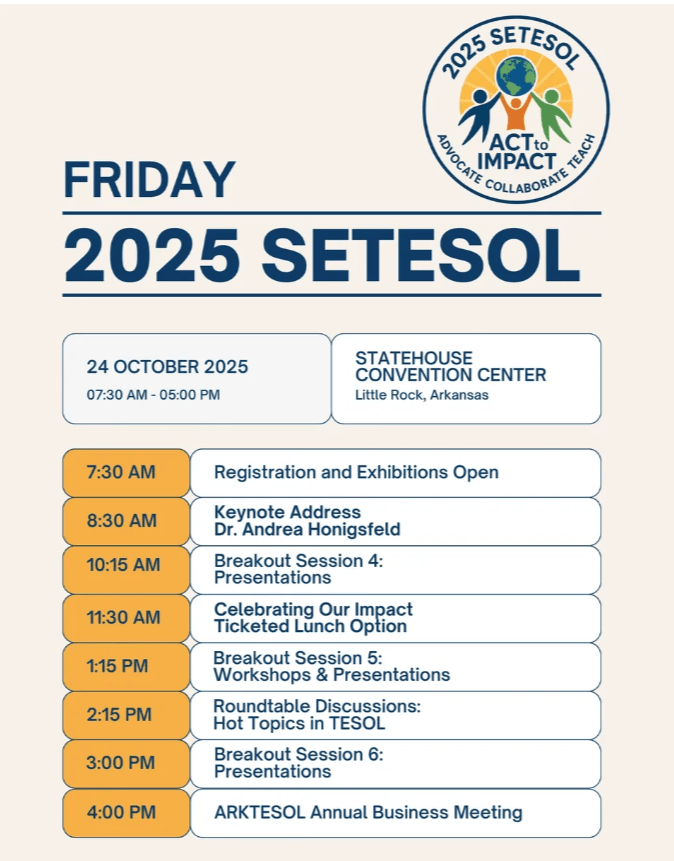
Later this week, I’ll be joining educators from across the Southeast at SETESOL 2025, where the conference theme, ACT to Impact: Advocate, Collaborate, and Teach, sets the tone for a gathering rooted in action, fairness, and community. I’m honored to present a workshop titled “Structured Writing Strategies for Beginner English Learners”, and as I prepare to share, I find myself reflecting on how deeply that theme resonates with the work I’ve been building through I Want to Learn English.
The theme’s three pillars (advocate, collaborate, and teach) are not abstract aspirations. For those of us working with newcomer English learners, especially adults and students with limited formal education (SLIFE), they are daily imperatives. They define how we serve learners who are often overlooked in traditional literacy frameworks and underrepresented in research. And in many ways, they define why I created the writing assessment and instructional materials I’ll be showcasing at the conference.
Assess to Impact: Advocacy Through Clarity
We can’t teach well if we don’t know what our students can do. But for too long, writing instruction (especially for newcomers) has been treated as optional or secondary. Even now, beginner writing is often framed as little more than handwriting or copying. The truth is, writing is not an add-on. It’s a integral part of language development. It is where students begin to take ownership of the words they speak, read, and hear. And when we assess writing authentically, we uncover the full range of their linguistic landscape.
The writing assessment tool I designed (currently in beta testing) was created with a clear conviction: teachers need practical, purposeful tools that respect both their time and their learners’ potential. Too often, the assessments available to us are cumbersome, bureaucratic, and misaligned with the real demands of teaching beginners. For those working with Level 1 English learners (especially adults with limited classroom hours) it’s critical to quickly identify where students are in their writing development and to use that information to drive meaningful instruction.
This tool was built to do just that. It offers a streamlined, four-part structure that assesses not just writing mechanics, but the deeper skills of phonemic awareness, sentence construction, and personal expression. Rather than reducing writing to a grammar checklist, it allows educators to see what learners are trying to say, and what their errors reveal about their grasp of the language. Because in every misspelled word, in every sentence fragment, there’s insight into how a learner is building English from the ground up. To overlook those moments would be a disservice. And as educators, we have to be honest about what will truly help our learners grow. Not just in test scores, but in confidence, communication, and agency.
Collaborate to Elevate: Tools for Teachers, by Teachers
At the core of my work is collaboration, and not just with students, but with fellow educators across classrooms and programs. That’s why I built the assessment around a clear, four-part structure and a detailed rubric: to give teachers a shared language for evaluating writing and supporting growth. When we can see student progress through the same lens, we can align instruction, celebrate wins, and adjust our teaching more precisely.
The SETESOL conference is a powerful reminder that we’re not in this work alone. The community of TESOL professionals—especially those who show up for SLIFE and adult learners—is resourceful, passionate, and ready to innovate. I’m looking forward to learning from others this week, sharing strategies, and exploring ways we can refine our tools together.
Teach for Transformation: Writing as Agency
Of course, the ultimate goal of assessment is not scoring, but for tailoring instruction. And teaching writing to English learners, particularly those who are just beginning, is one of the most transformational acts we can engage in. Writing gives students agency. It gives them room to tell their own stories, on their own terms, in their own unique, emerging voice.
In my session, I’ll walk participants through a progression of structured writing strategies that start with phonics and sound awareness and lead into sentence construction and short narratives. These strategies are scaffolded, accessible, and culturally responsive. They are designed to help learners move from sound to word to meaning, and to produce writing that is not only technically accurate, but personally relevant. In this way, writing becomes more than a skill. It becomes a bridge: from the known to the unknown, from the oral to the written, from surviving in a language to thriving in it.
From SETESOL to the Classroom and Beyond
As I head to SETESOL from the east coast, I’m thinking about the learners whose writing inspired this work: the student who wrote their first sentence after weeks of practicing phonics; the adult who shared a personal story in English for the first time; the teacher who needed a way to show that their students were making progress, even when standard tests said otherwise.
This is why I continue building tools, writing books, and creating space for others to share what works. Because advocacy without action is incomplete. Those of us that not only “talk the talk”, but “walk the walk” understand this field is always upgrading. And the sharing of good ideas that are practical and effective is gold. But collaboration without tools falls short. And teaching without a belief in what’s possible limits everyone involved.
If you’re attending SETESOL in Little Rock, Arkansas, I’d love to connect. My session, “Structured Writing Strategies for Beginner English Learners,” will offer concrete, usable tools for assessment and strategies for instruction. And whether you’re working with adults, teens, or multilingual middle schoolers, I hope you’ll leave with something that helps you teach (and reach) more effectively. And if you can’t make it, I will share my presentation for all to see so stay tuned for that. In fact, subscribe to this website so you never miss an update or article.
Remember when we ACT to impact, we don’t just change instruction, we change lives.
Leave a Reply